
Fully-Automated Systems
Another trading strategy is to use a fully-automated system. These systems allow traders to fully automate a trading method including their entries and exits. NinjaTrader allows you to fully customize when, where and how to take trades. One of the most beneficial parts of using an automated system is to remove the emotions and stress of trading. Negative emotions can cause us to enter trades we wouldn’t normally take, typically resulting in losing trades. Everyone needs to understand the importance of emotions/psychology in day trading. Another upside to using an automated trading strategy is the ability to back test. NinjaTrader allows you to test your strategy on historical data, allowing you to find the best setups. A screenshot of the NinjaTrader strategy analyzer can be found below. It is important to note that even though a strategy may have performed well in the past, this does not guarantee that these returns will continue.
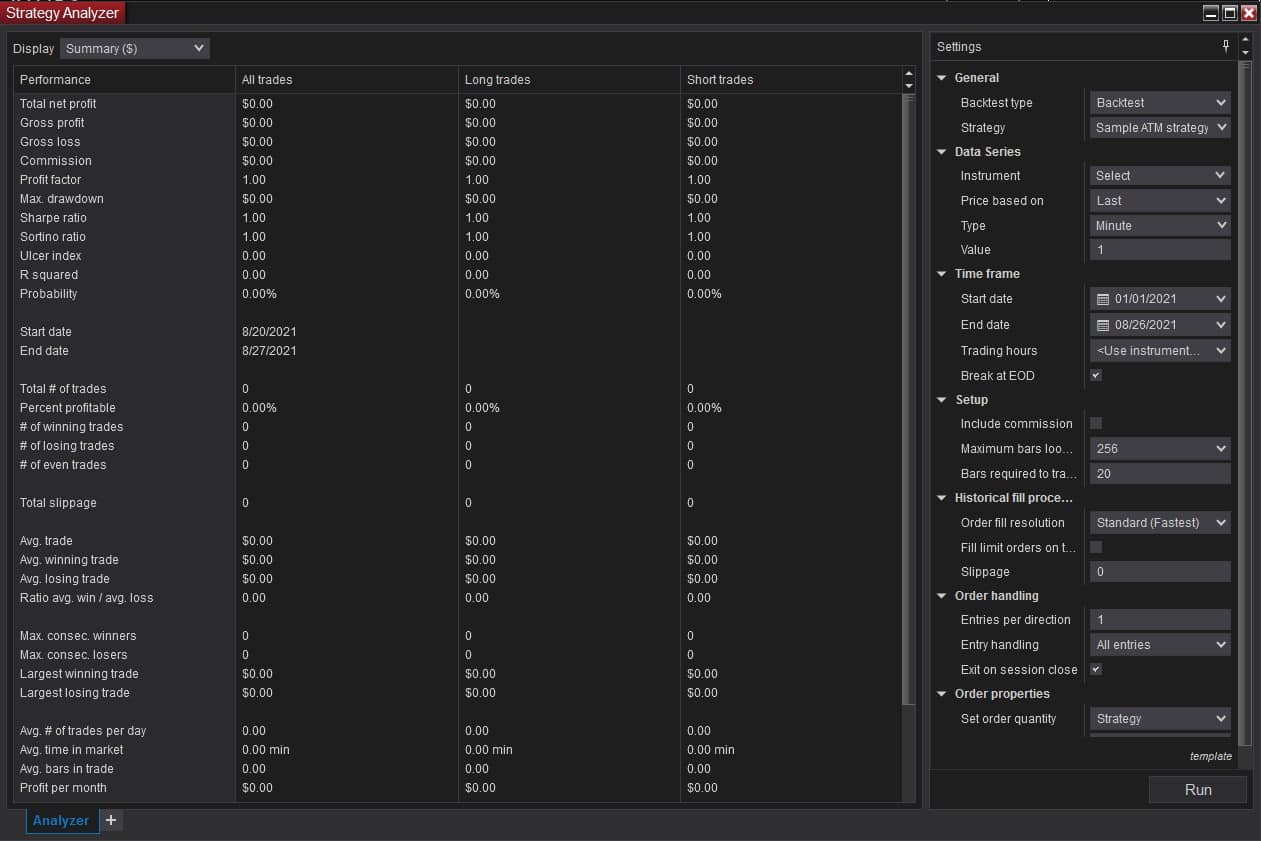
How automated trading works in NinjaTrader
An automated strategy is a written-down set of rules that NinjaTrader follows for you: when to enter, how many contracts to trade, where the stop and target go, and when to get out. In NinjaTrader Desktop you can build one without writing code in the Strategy Builder, or write it in NinjaScript (C#) when you need full control. The strategy then runs on a chart or from the Strategies tab of the Control Center, and it only trades while NinjaTrader is open and connected.
Fully automated or semi-automated?
A fully automated system takes every entry and exit on its own. A semi-automated approach leaves the entry to you and lets the platform manage everything after it: the stop, the target, the breakeven move and the trailing stop. Many discretionary traders get most of the emotional benefit of automation from automating the exit alone, because the exit is where fear and hope do the most damage. NinjaTrader’s ATM Strategies do this natively, and our Advanced Exit Orders Management module adds ATR-based stops, previous-bar stops and trailing methods you can switch while you trade.
Test a strategy before it trades real money
- Backtest on enough history. Use the Strategy Analyzer on a period that includes trending days, choppy days and high-volatility news days. A strategy tested only on one kind of market will only work in that kind of market.
- Include commission and slippage. A strategy that is only profitable with perfect fills is not profitable.
- Keep some data out of sample. Optimize on one period, then test on a period the optimizer never saw. NinjaTrader’s walk-forward optimization automates this check.
- Forward test on simulation. Run it on a simulation account (Sim101) or on Market Replay data through the Playback connection, and compare the results with the backtest.
- Go live small. Start with the smallest size available, such as one Micro contract, and only scale up when live results look like the test results.
The mistakes that sink most automated systems
- Curve fitting. Adding parameters until the backtest looks perfect usually produces a strategy that only fits the past. Fewer rules that work across many markets and periods are more trustworthy than many rules that work on one.
- Ignoring market conditions. A trend-following system loses money in a range, and a mean-reversion system loses money in a trend. Know which conditions your system needs and what it does without them.
- Leaving it unattended. Internet drops, Windows updates, platform restarts and data outages all happen. Check on a running strategy, and know how to disable it and flatten the position quickly.
- Breaking prop firm rules. Many prop firms restrict or ban fully automated trading on funded accounts. Read your firm’s rules before you run a strategy on one.
Add a safety net the strategy cannot override
A bug in a strategy can keep sending orders long after it should have stopped. A daily loss limit that sits outside the strategy protects the account even when the strategy’s own logic fails. Our Account Risk Manager adds a daily loss limit and profit goal per account, tracks trailing drawdown on prop firm accounts, and closes positions when a limit is hit. Before you automate, it also helps to write your rules down in a trading plan; a system is just a plan precise enough for a computer to follow.