
Volume and Delta
Volume and Delta are two measurements of the market that can help in making trades. More information about these indicators can be found below.
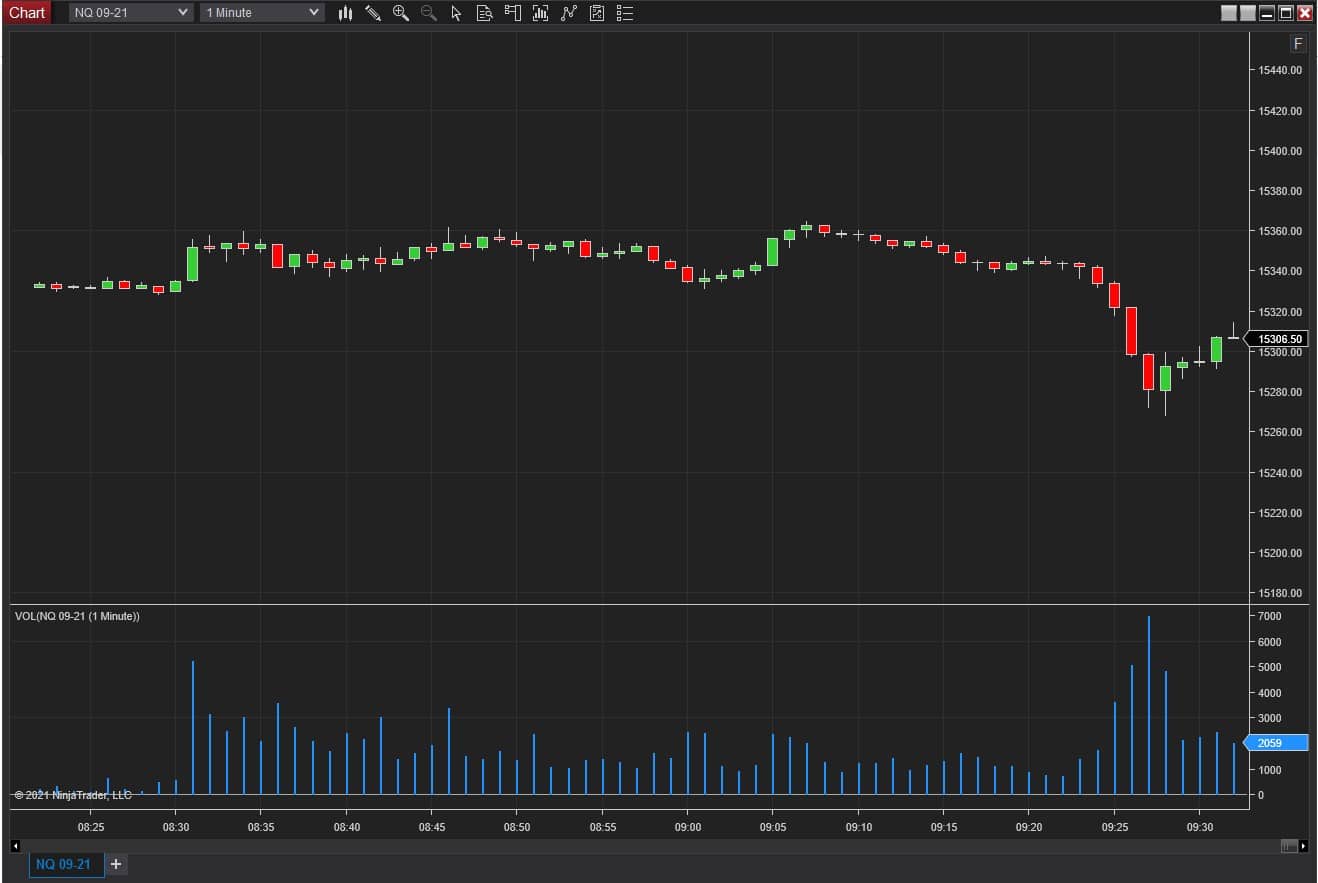
Volume: Volume is defined as the amount of a security or asset that changes hands over a period of time. For example, a stock’s trading volume refers to the number of shares of that security that were traded between the day’s open and close. Volume is a key indicator when measuring the significance of a market move. High volume refers to a more significant move in the market and vice versa. Below is a screenshot from NinjaTrader with use of their volume indicator.
Delta: Delta has several different meanings in the trading world. In this case we want to look specifically at Order Flow delta.
One form of Order Flow delta is calculated by taking the difference between the number of orders traded at the bid and ask. Another form of Order Flow delta is the sum of up-tick/down-tick data. More information on up-tick/down-tick Order Flow can be found here in our order flow trading guide. As an example, let’s say that a bar has 500 contracts traded on the up-tick and 1000 contracts traded on the down-tick. The total delta for this bar would be -500 (1000-500).
Similar to volume, delta provides information on how strong a move is. An up-bar with a high delta shows that there is a significant move in that direction. On the other hand, an up-bar with low delta (or even negative delta) shows a less significant move in that direction.
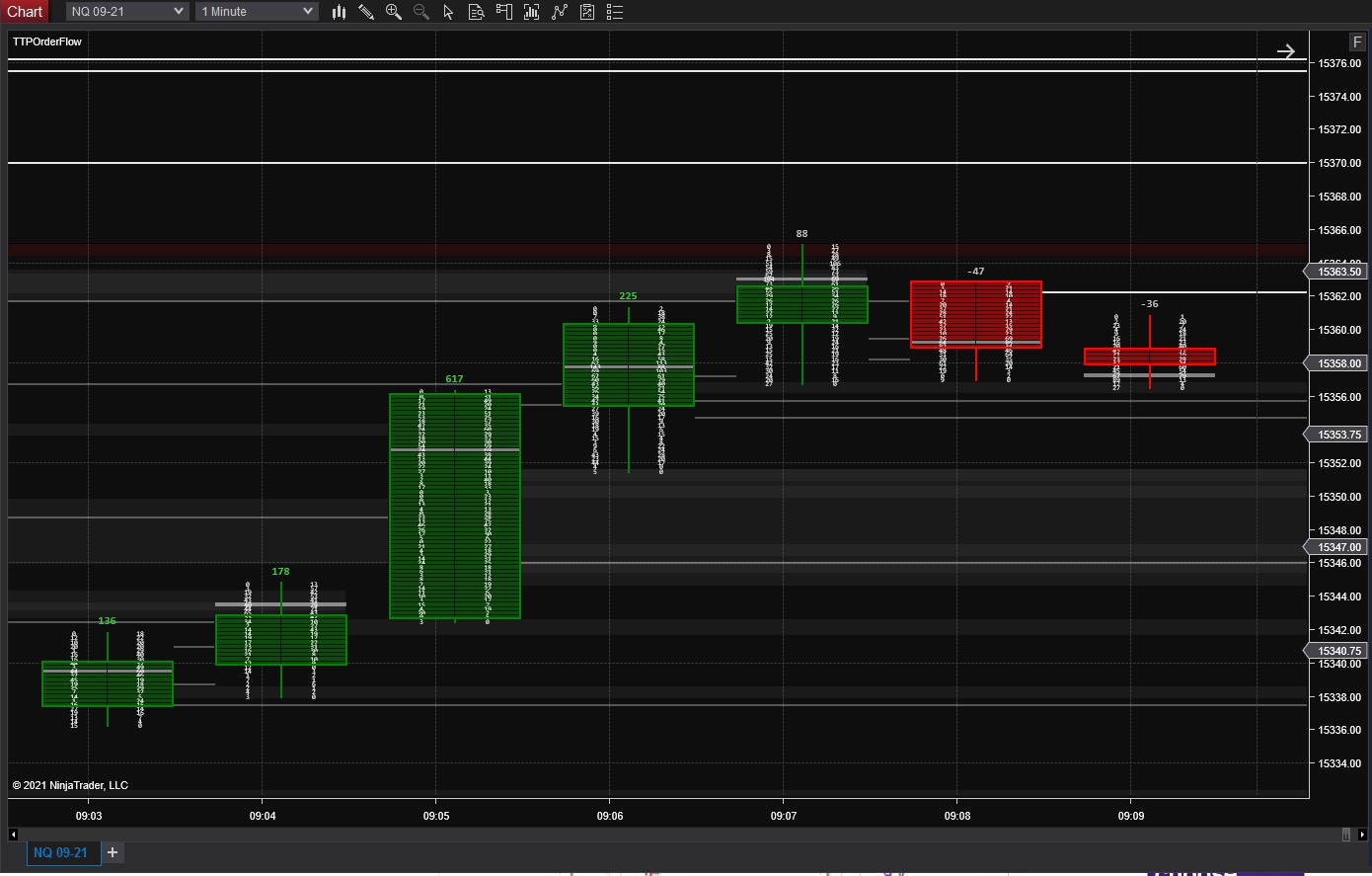
Below is a screenshot from our Order Flow System that shows the overall delta for each bar.
How to Read Volume: Volume tells you how much participation there is behind a move. A rally on rising volume shows many traders taking part, while a breakout on light volume is more likely to fail and fall back into the range. A very large volume spike after a long move can mark climactic buying or selling near the end of that move. Volume is best judged against its own recent average and the time of day, since overnight futures sessions usually trade much less than the regular session.
Cumulative Delta: Cumulative delta keeps a running total of each bar’s delta through the session. When price makes a new high but cumulative delta does not, buying pressure may be weakening, which is often called a delta divergence. When there is heavy selling delta at a level but price stops falling, passive buyers may be absorbing that selling. In NinjaTrader Desktop, these readings come from NinjaTrader’s Order Flow+ tools, such as Volumetric bars and Cumulative Delta, or from third party order flow indicators.
Mistakes to Avoid: Delta and volume describe what has already traded. They do not predict the next bar on their own, so most traders read them at important price levels rather than on every bar. Also remember that delta values can differ between platforms and data feeds depending on whether trades are classified by up-tick and down-tick or by bid and ask.
Frequently Asked Questions
Is positive delta always bullish? No. Positive delta means more contracts traded at the ask (or on up-ticks) than at the bid. If price does not rise with it, those aggressive buyers may be running into large passive sellers.
Where can I find order flow tools for NinjaTrader? You can see our tools for reading delta, imbalances and volume in our order flow software section.
What counts as high volume? There is no fixed number. Compare a bar’s volume with the average volume at the same time of day, because the regular session open is normally far busier than the lunch hour or the overnight session.
Is delta the same as volume? No. Volume counts every contract traded, while delta is the difference between buying and selling volume, so a bar can have very high volume and a delta close to zero.