
Other Common Indicators
There are countless indicators traders use on their charts. Below you can find more information on some of the more common ones.
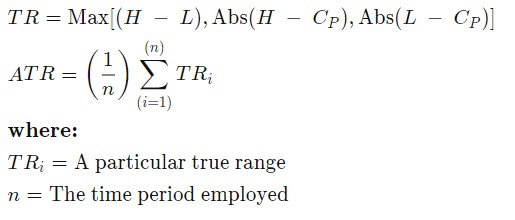
Average True Range (ATR): The ATR is a measurement of market volatility. The higher the ATR, the higher volatility in the market. The ATR is typically calculated from the 14-day simple moving average. The formula can be found below, taken from Investopedia.
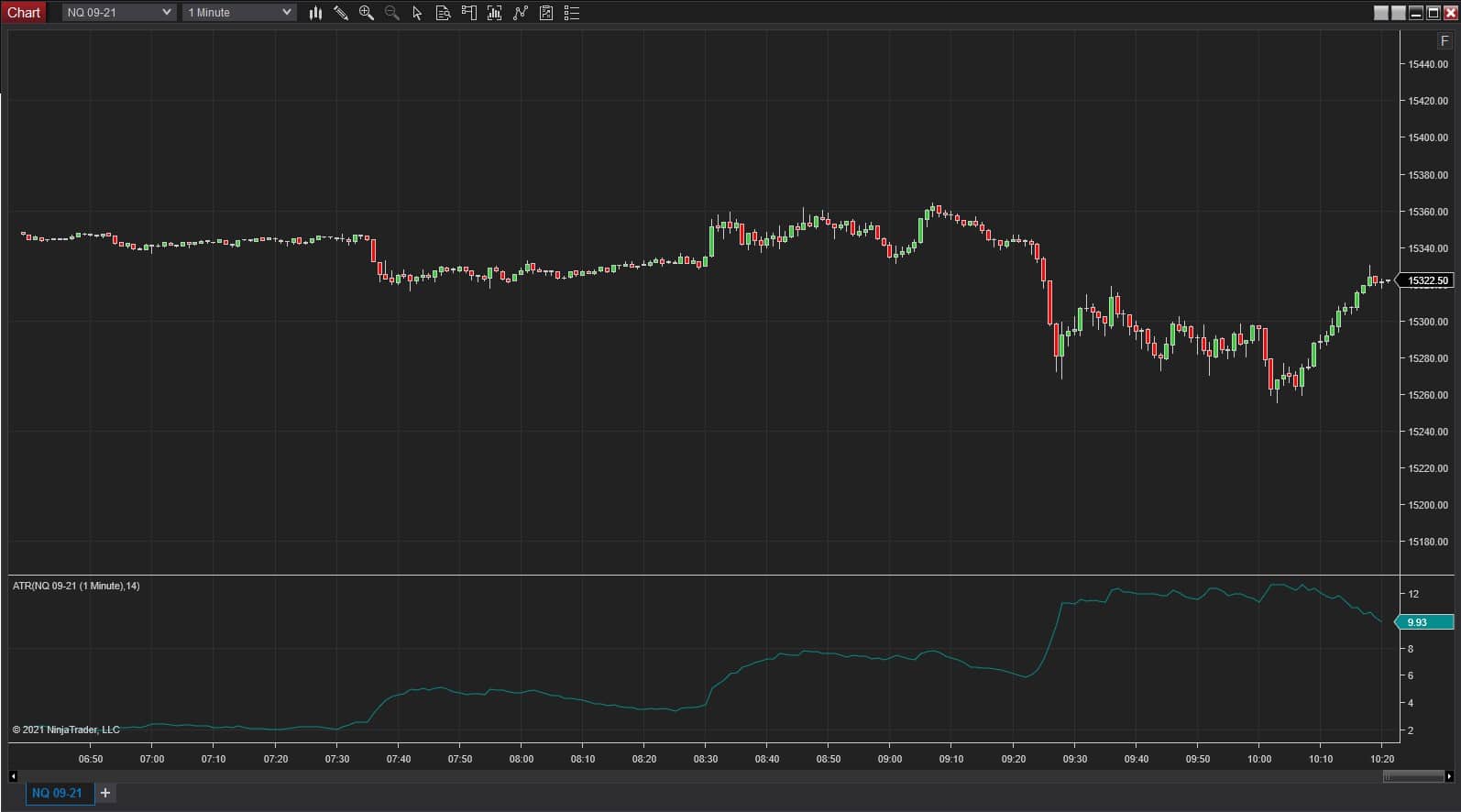
The screenshot from NinjaTrader below shows a chart with an ATR 14 on it. Looking at the chart, there was an increase in the ATR as volatility began to pick up (as seen by the bigger market moves). As volatility began to decrease, the ATR went down.
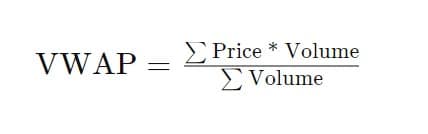
Volume Weighted Average Price (VWAP): The VWAP is a key indicator used by many traders to help determine a market’s trend or security’s value. It provides the average price a security has traded at based on its volume and price for that day. One way it can be used in day trading is with a support and resistance strategy, more info here about support and resistance trading. On NinjaTrader 8, our free VWAP Studio plots VWAP with standard deviation bands and anchored VWAPs. The VWAP formula can be found below, taken from Investopedia.
Relative Strength Index (RSI): The RSI, developed by J. Welles Wilder, is a momentum oscillator that moves between 0 and 100. The most common setting is 14 periods. Readings above 70 are traditionally called overbought and readings below 30 oversold. In a strong trend the RSI can stay overbought or oversold for a long time, so many traders use it to spot divergence (price making a new high while the RSI makes a lower high) rather than as a stand alone sell or buy signal.
MACD (Moving Average Convergence Divergence): The MACD line is the difference between a 12 period and a 26 period exponential moving average. A 9 period EMA of that line, called the signal line, is plotted with it, and the histogram shows the distance between the two. A MACD line crossing above the signal line points to rising momentum, and a cross below points to falling momentum. Because it is built from moving averages, the MACD lags price.
Bollinger Bands: Bollinger Bands plot a moving average with a band above and below it, set a number of standard deviations away. The classic setting is a 20 period average with bands 2 standard deviations wide. The bands widen when volatility rises and narrow when the market is quiet. A narrow stretch, often called a squeeze, is frequently followed by a larger move, although the bands do not tell you its direction.
Using ATR for Stops: Because the ATR measures how far the market typically moves, many traders size their stops as a multiple of it, for example 1.5 to 2 times the ATR, so a stop is not placed inside normal market noise. The ATR shows how much the market is moving, not which way.
Mistakes to Avoid: Avoid adding several indicators that measure the same thing, such as two or three momentum oscillators, because they will simply agree with each other. Pick one tool for trend, one for momentum or volatility, and learn how each behaves on the bar type and session you trade. ATR, RSI, MACD and Bollinger Bands all come with NinjaTrader Desktop, and you can find more tools in our trend and classic indicators collection.
Frequently Asked Questions
Which indicator should a beginner start with? A moving average and the ATR are a good start. One shows the trend and the other shows how far the market usually moves, which helps with stop placement and position size.
Do these indicators work on tick and range charts? Yes. They calculate on whatever bars are on the chart, so a 14 period RSI on a range chart covers 14 range bars, not 14 minutes.
Can I change the default settings? Yes. Every setting can be changed in the indicator’s properties when you add it to the chart. Change one setting at a time and compare the result on past data, so you know what the change actually does.